

Sociology
Undergraduate Program Overview
All Students
**
Learn to Understand & Shape the Social World
As the flagship program of the Department of Social and Cultural Studies, the redesigned Bachelor of Arts in Sociology offers students a flexible, interdisciplinary, and contemporary approach to understanding people, systems, and the dynamics of socio-cultural change. Built around five new concentrations, the program engages with emerging trends in society and culture, and builds upon the strengths of Nipissing faculty.
Students gain skills in critical thinking, research, communication, and policy analysis; tools that translate directly into meaningful careers in community services, health, education, public policy, advocacy, media, arts, culture, and heritage and more.
Program Highlights
Areas of focus: Explore issues including health and aging, education and social inequality, housing insecurity, digital media, global conflicts, social movements, and the climate crisis.
Interdisciplinary training: Learn to approach social and cultural issues from multiple perspectives.
Field placement: Gain hands-on experience tackling real-world problems through direct involvement in faculty research projects, internships and your own independent study.
Methods and theory training: Develop practical skills through training in qualitative and quantitative research methods and receive a firm grounding in diverse theoretical perspectives to better understand social and cultural patterns and processes.
Research tools and data skills: Work with datasets, archival resources and media artifacts to uncover trends, answer questions, and develop evidence-based solutions.
Small classes and faculty mentorship: Enjoy personalized guidance, meaningful discussion, and hands-on mentorship from professors who connect theory to practice in health, media, education, social and environmental justice, and more.
Program-Related Certificates:
Choose Your Concentrations
Complete core courses and select one or more of our five concentrations:
- Health, Death & Wellness: Explore how societies understand and navigate health, illness, wellness, mortality, and end-of-life care. Ideal for students interested in medicine and public health, wellness advocacy and deathcare.
- Education & Society: Examine how education systems shape social identities, opportunities, and inequalities. Great for students considering careers teaching, education, youth support, or community programming.
- Social Analysis & Public Policy: Develop strong research and analytical skills to evaluate social issues and public policies. A strong fit for students interested in government, policy work, program evaluation, or applied social research.
- Environment & Social Justice: Learn how social inequities give rise to movements for social and environmental justice. This concentration prepares students for careers in community organizing, law, social and environmental policy, climate justice, sustainability and conservation, and immigration and refugee work.
- Media, Communication & Culture: Analyze media, technology, artificial intelligence, culture, and identity and their impact on social life and political action. Excellent preparation for careers in communications, media, cultural organizations, or creative industries.
Resources
Program Related
Why Nipissing's Sociology Program?
Diverse faculty expertise
Faculty bring applied and community-based perspectives from organizations such as health and social services, cultural institutions, justice systems, education, and government agencies.
Hands-on research opportunities
Conduct real-world research, work as a faculty research assistant, or engage in community-based projects that apply sociological theory to contemporary issues.
Access to data & resources
Use the Stats Can Research Data Centre located on campus as well as databases and archival resources accessible through the Nipissing library, and take advantage of professional associations and research guides.
Small class sizes and close mentorship
Collaborate, discuss and receive personalized guidance from faculty throughout your degree and take advantage of independent study and Honours thesis opportunities.

Admission Requirements
To qualify for admission, students must meet the General Admission Requirements, plus program-specific prerequisites.
General Admission Requirements include:
Ontario Secondary School Diploma including six 4U/4M courses
Future Careers
A degree in Sociology from the Department of Social & Cultural Studies at Nipissing opens doors across many sectors. Graduates may pursue roles in:
Community & Social Services
Social workers, community support staff, youth engagement coordinators.
Health & Wellness Fields
Public health analysts, palliative care support workers, wellness facilitators.
Education & Outreach
Educational program assistants, community educators, student support professionals.
Research & Policy
Policy analysts, data analysts, research associates, program evaluators, market research analysts.
Media & Cultural Industries
Communications specialists, digital media professionals, content writers, professionals in the field of arts and culture.
Government and non-government organizations
Community development officers, lawyers, consultants, and social or environmental impact assessors.
Real People, Real Impact

The class sizes allow professors and teaching assistants to get to know you– and for you to get to know them, which makes a world of a difference when it comes to fully engaging in course material and feeling comfortable enough to ask questions.
Tanner B.
Class of 2026
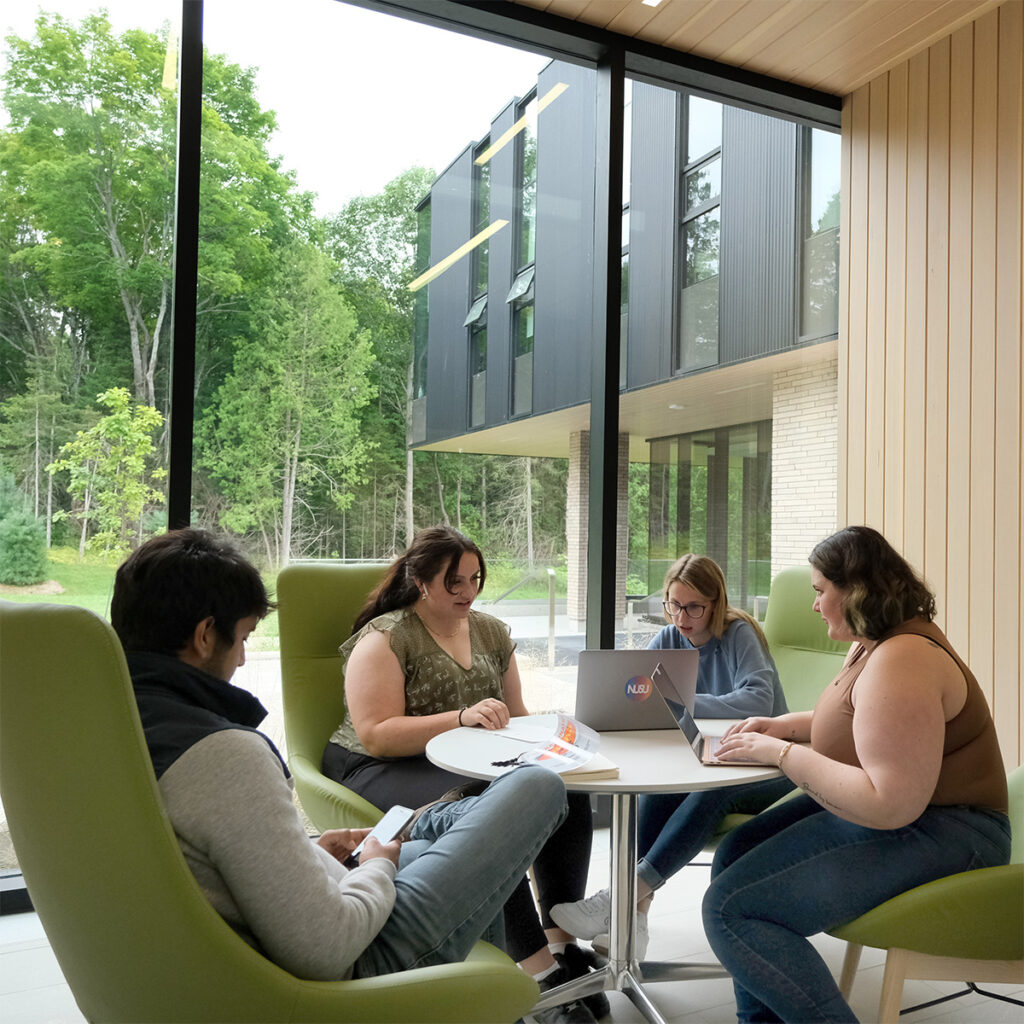
The class sizes are small which means I get the opportunity to talk to my professors in a way that makes me feel as if they value my learning. I feel comfortable going to talk with my professors and I feel supported in my education.
Abby C.
Class of 2028
Program Requirements
How the Common Degree Structure Works
At Nipissing, you can choose a minor, major, specialization, or honours specialization – each offering a different level of focus and flexibility to match your goals.
Check out this breakdown of the Common Degree Structure to see how you can make your interests fit your degree.
Program Options & Course Requirements
Find required courses for each type of specialization using this link.
Request More Info
Explore Other Programs
See All Programs

Notes:
An Anthropology Stream is available to students completing the Honours Specialization, Specialization, or Major option in Sociology.
Disclaimer:
While every effort is made to ensure accuracy on this site, in the event of a discrepancy, Nipissing’s Academic Calendar is the official reference.